Our take
Use LiFePO4 as a chemistry filter, then choose by your energy and output requirements. Read cycle count together with its remaining-capacity threshold, and check charging limits separately from discharge limits. A larger cycle number cannot compensate for an undersized battery.
Research-based buying guide, not hands-on tested. Specifications and certification claims are attributed below; calculations are estimates. No paid placement or affiliate tracking links appear on this page.
LFP is a lithium-ion chemistry, not a runtime rating
LiFePO4 means lithium iron phosphate; LFP is the common abbreviation. It is one member of the lithium-ion family. A listing that says only “lithium-ion” does not tell you which chemistry the product uses. Retail comparisons with “lithium-ion vs LiFePO4” often mean another chemistry such as NMC/NCM versus LFP.
A LiFePO4 portable power station combines the battery with battery management, charge electronics and supported outputs. A bare 12 V LFP battery is a different product: it does not become a household AC supply without appropriate additional equipment. Compare complete systems when the task is powering a campsite or plug-in home essentials.
Do not infer that every LFP station has the same durability, safety protections or usable capacity. Check the exact manual, certifications applicable to the complete product and the operating limits. Chemistry does not make a damaged pack safe to use or turn a battery into weatherproof equipment.
Compare the specifications that affect your trip
| Specification | Question it answers | Common mistake |
|---|---|---|
| Battery Wh | How much nominal energy is stored? | Using mAh without the reference voltage |
| Continuous AC watts | Can it power my simultaneous AC load? | Substituting peak or boost watts |
| Cycle life + threshold | What cycling outcome does the manufacturer claim? | Comparing counts with different capacity thresholds |
| Charging temperature | Can it accept a charge where I will use it? | Reading the discharge range instead |
| Solar input | Can this panel array charge the station? | Checking watts while ignoring voltage and current |
| Carry weight & dimensions | Can I move and store the complete setup? | Comparing battery-only weight with a full kit |
For a simple runtime comparison, a hypothetical 1024 Wh battery at a constant 100 W yields 1024 × 0.85 ÷ 100 ≈ 8.7 hours. A 2048 Wh battery at the same load gives about 17.4 hours. These are planning estimates with a shared factor, not evidence that all LFP stations deliver the same measured AC energy.
Low-load inverter consumption, temperature, age and shutdown settings can change the usable result. USB and DC outputs can also behave differently from AC. For a camping battery, calculate the complete weekend in the camping power supply guide before filtering by chemistry.
A cycle count is incomplete without the capacity threshold
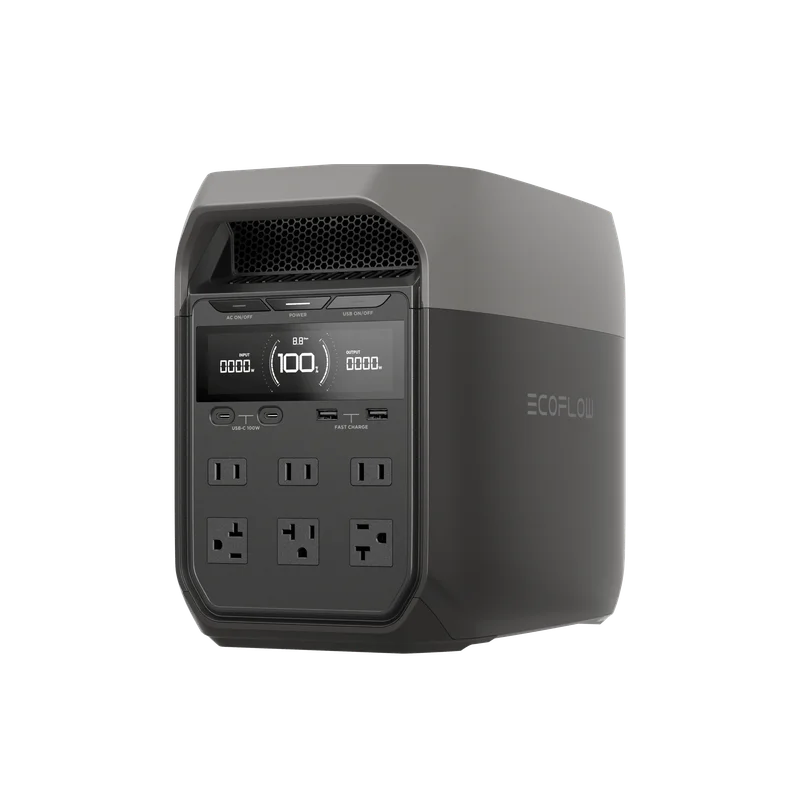
EcoFlow DELTA 3
4,000 cycles → 80%+
Manufacturer’s stated remaining capacity
User manual (PDF) ↗
EcoFlow product image
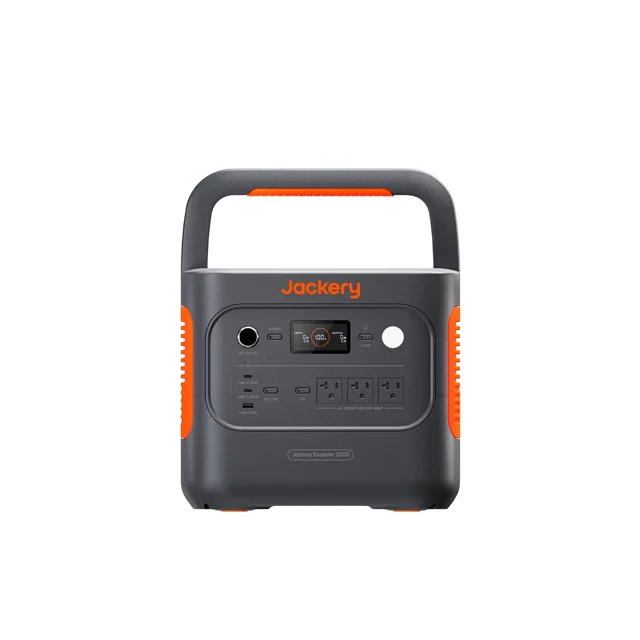
Jackery Explorer 2000 v2
4,000 cycles → 70%+
Manufacturer’s stated remaining capacity
U.S. user manual (PDF) ↗
Jackery U.S. product image
Same cycle count, different capacity endpoints. These claims do not establish a controlled durability comparison; test conditions also need to match.
A cycle-life threshold describes retained capacity after the specified use conditions. It does not mean the pack becomes unusable on the next cycle, nor does it guarantee that every component of the power station will last the same number of years. Calendar aging continues even when the station is rarely discharged.
Read the warranty separately: territory, authorized seller, registration requirements, exclusions and the remedy offered. A long cycle-life advertisement is not itself a warranty to replace a battery after a particular number of camping seasons.
Charging, discharge and storage have separate limits
Jackery’s U.S. Explorer 2000 v2 specification lists 0–45°C for charging and −10–45°C for discharge. Anker’s U.S. C2000 Gen 2 guide lists a 0–40°C charging range. These are examples for those exact products, not universal limits for every LFP station.
For a winter campsite, check whether the battery is warm enough to charge, not just whether the air feels tolerable. If a model supports internal heating, follow its documented procedure and account for the energy it consumes. Do not bypass low-temperature charge protection.
Storage also has model-specific temperature, charge-level and maintenance instructions. Avoid assuming that leaving the station fully charged in a hot vehicle is equivalent to storing it under the manufacturer’s recommended conditions. Check it before a trip rather than discovering a depleted or faulted battery at camp.
A LiFePO4 solar generator still needs a compatible array
“LiFePO4 solar generator” and “LiFePO4 solar power station” usually refer to an LFP station with solar-charging capability. They do not establish that panels are included. A station can also support grid or vehicle charging; verify exactly what the bundle contains.
For panel compatibility, read input voltage and current as well as the watt ceiling. Account for panel open-circuit voltage under cold conditions and the required connector/polarity. Do not wire panels based on a generic diagram intended for another station.
For an illustrative energy budget, 200 W × four peak-sun-hours × 0.8 yield equals 640 Wh in a day. That figure depends on the assumptions and says nothing about output during a storm or at night. Size battery energy for the period when charging will be unavailable.
Choose the system in this order: energy budget, simultaneous load, recharge plan, portability and support. Then compare chemistry and durability claims among models that already fit. Our home backup comparison shows why nearly equal battery capacities can come with very different solar-input limits.
Sources & methodology
Checked 2026-11-01. Product examples are exact U.S. versions. We attribute manufacturer cycle-life claims rather than presenting independent durability evidence; the runtime and solar arithmetic use disclosed planning assumptions.
- EcoFlow DELTA 3 specifications — LFP chemistry and the stated cycling threshold.
- Jackery Explorer 2000 v2 specifications — chemistry, cycling threshold, charge/discharge limits.
- Anker C2000 Gen 2 U.S. user guide — charging temperature and electrical limits.
Frequently asked questions
What is a LiFePO4 power station?
It is a portable power station that uses lithium iron phosphate battery chemistry, also called LFP. A finished station includes more than battery cells: battery management, charging electronics, outputs and usually an AC inverter. Chemistry alone does not determine output, usable capacity or runtime.
Is LiFePO4 different from lithium-ion?
LiFePO4 is a type of lithium-ion battery. Retail comparisons often use “lithium-ion” to mean a different cathode chemistry such as NMC or NCM. Compare the exact chemistry and model specifications instead of treating LiFePO4 and all lithium-ion batteries as separate categories.
Does a LiFePO4 solar generator include solar panels?
Not necessarily. The term often describes an LFP power station that supports solar charging. A solar kit may include panels, while a station-only listing may not. Verify panel quantity, cables, input voltage/current and connector requirements.
Do 4000 cycles mean 4000 days of guaranteed battery life?
No. A cycle-life rating describes a manufacturer’s cycling conditions and a remaining-capacity threshold. It is not a calendar-life guarantee or a runtime measurement. Partial cycles, age, temperature, usage and warranty terms matter.
Can I charge a LiFePO4 power station below freezing?
Follow the exact model’s charging-temperature limits and any supported internal-heating procedure. For example, Jackery lists 0–45°C charging for the Explorer 2000 v2, while Anker lists 0–40°C for the U.S. C2000 Gen 2. A permitted discharge temperature does not establish a permitted charging temperature.